New Life LIVE: August 19, 2026
Ministries > New Life LIVE with New Life

Caller Questions & Discussion:
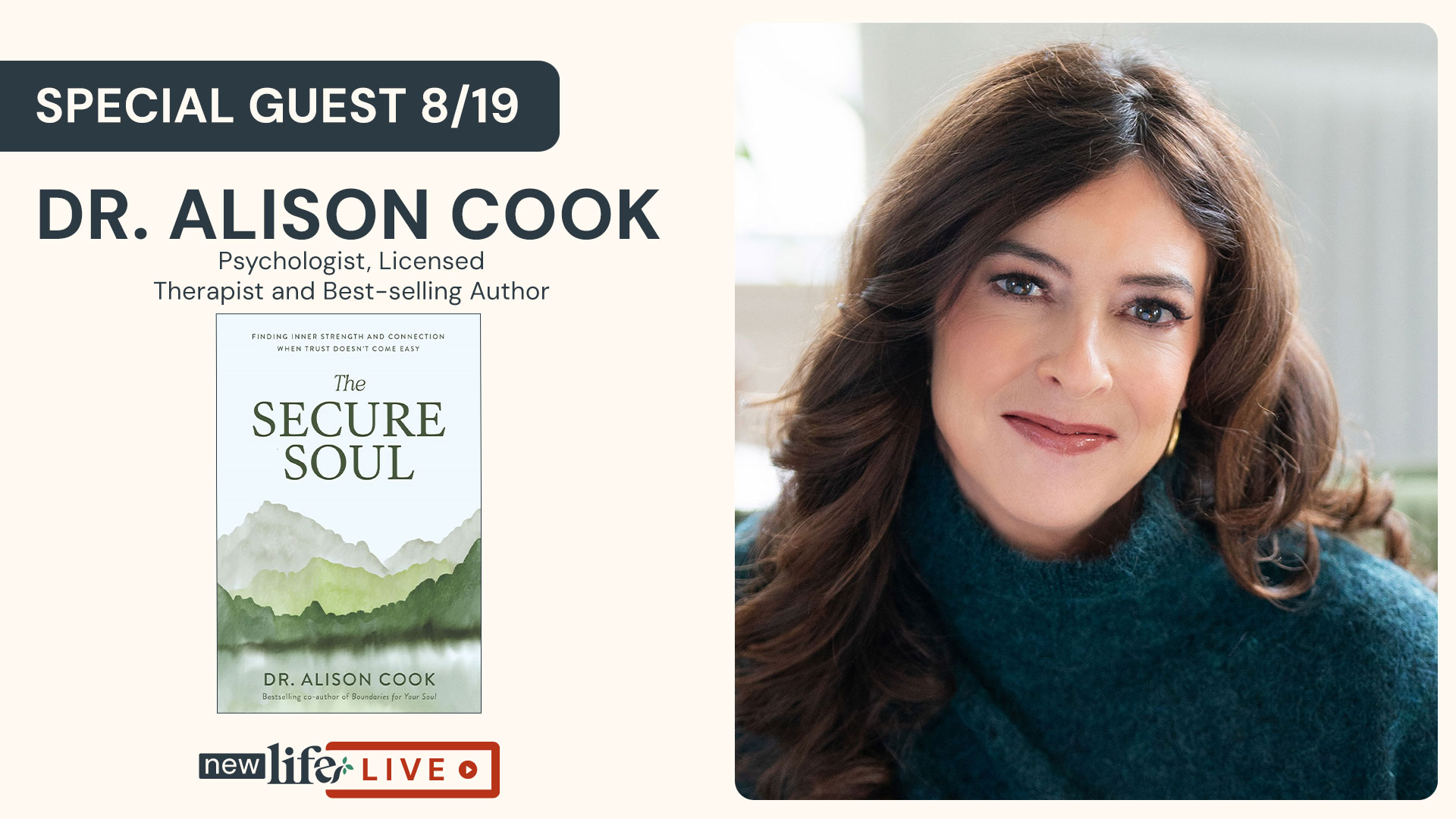
- Dr. Alison Cook, psychologist, podcaster, and attachment-style expert, discusses her newest book The Secure Soul and how she wove experiences from childhood into adulthood. She asks the question: What does it mean to connect with yourself, especially the younger version of yourself?
- What is fueling feelings of insecurity?
- Where is God in times of trials?
- What is your definition of the word soul, and how do we know that we need to tend to our soul?
- I’m struggling at work and feeling lonely. I left work today just for the afternoon because it’s a toxic environment. I overextend myself, and it makes me feel empty.
- Some people believe the past should be left in the past. Why is it important that we revisit experiences from our childhood and youth?
Announcer: Welcome to the New Life Live podcast. We hope to provide help and hope in your life through God's word, counselors, and psychologists as we answer questions from listeners who call with the challenges of life. Let's go to today's episode.
Brian Perez: Hello everyone, welcome to New Life Live. I’m your host Brian Perez, and we’ve got a great show for you today. Joining me is licensed professional clinical counselor Becky Brown. She's also the president of New Life Ministries. Hi boss, how are you?
Becky Brown: Hi Brian. I am so excited about this program. Dr. Allison Cook is going to join us, but go ahead and introduce her, Brian.
Brian Perez: Definitely. She is a psychologist of religion, a licensed therapist, a leading voice in attachment theory, and a bestselling author. I’m running out of breath here because she’s done so much. She also hosts a podcast called The Best of You. We’ll be talking with her today about her latest book, The Secure Soul: Finding Inner Strength and Connection When Trust Doesn't Come Easy. Dr. Cook, welcome to New Life Live.
Dr. Allison Cook: Thanks so much for having me. It’s a delight to be with you today.
Becky Brown: I’m excited because I have been listening to your podcast over the years. Before the show, I was telling Dr. Cook that I had seen her from a distance and was kind of fan-girling, but I didn’t go up and introduce myself because I didn’t want to be that person. I just appreciated the clarity in which you speak truth and the compassion that you provide. I love the book. I’ve already read the book. Brian usually beats me to the punch on that one. We teach attachment theory here. We don’t call it that, but we talk about attachment styles. We teach our couples about attachment at our intimacy and marriage intensive. I knew when I read the book, our listeners would love what you had to share about attachment and how it impacts our walk with God.
Dr. Allison Cook: Everything I do is that intersection of attachment—which is really just a fancy word for connectedness, how we connect to ourselves, to others, and to God—and then the inner work. I zoom in on the inner component of that, which is the least talked about component: the inner work that we do to connect to ourselves and to God. We also have an attachment relationship, a connection with God, that is influenced by our wounds and by the ways we were shaped. I bring everything in with spiritual formation, really trying to zoom in on how we're formed. This book was just a lot of fun. This is the most vulnerable book I’ve written. It has more of my personal story through healing some of my own wounds in partnership with God’s Spirit. It zooms in on the inner work that I’ve done, so it was very healing to write. I'm thrilled to talk about it with you today.
Becky Brown: I noticed that even in the writing. It is personal, but it's also very poetic as you get into the story. I love that idea because a lot of times when we read non-fiction, we put up our critic and think that doesn't apply to me, but you draw us into your story so beautifully. I appreciate the way that you deliver the message.
Dr. Allison Cook: I tried to show the work I zoom in on regarding the soul. That's what really interests me when we think about relationships. It's that relationship with ourselves that we often don't understand. It's so confusing to us. What does it even mean to have a relationship with yourself? I tried to be creative about how I connect with these younger versions of myself that carry some of the wounds that we all have.
Brian Perez: I love how you're very descriptive with the younger version of yourself. It takes you back to when you were little, when you were in college, the tight ponytail, and everything because it's almost like you're thinking of one particular event. We all have those times in our lives when we just remember. Think of yourself as a six-year-old, a ten-year-old, a four-year-old, whatever the case might be. We've got to take a break. We'll be right back on New Life Live with our guest, Dr. Allison Cook. 1-800-229-3000.
Announcer: To find out more information about New Life or to order any of the resources mentioned on today's program, call 1-800-NEW-LIFE. Now back to New Life Live.
Brian Perez: Dr. Allison Cook is our guest. She’s got this great new book called The Secure Soul: Finding Inner Strength and Connection When Trust Doesn't Come Easy. Becky Brown is here as well. Becky, what did you find fascinating about the book? Speak to the times that we’re living in and why we need books like this.
Becky Brown: Dr. Cook, you write how we are more psychologically informed than any people in history. I know that’s true. When you think back, we know more about how our emotions and our mental state work. We understand that, yet we’re so disconnected, unknown, unseen, and alone. What is fueling these feelings of insecurity?
Dr. Allison Cook: I find that to be a really fascinating phenomenon. As a therapist, as someone who really believes in the work of healing, all of the diagnostic labels and head knowledge don't always help. I might know my attachment style, but a lot of that stays at the level of head knowledge. A similar thing can happen in psychology with our psychology knowledge that can happen, honestly, with our faith when everything is only head knowledge and it doesn't come down into the depths and corners of our being and into our bodies and into our souls where we really experience transformation. That was one of the things as I was studying psychology 25 years ago. I also noticed that so much of this is heady. I can know something about myself or know something about my spouse or about my kids, but that knowledge doesn't always translate to more connection and a more lived and felt experience of presence and love and being with someone. These are the things I think we really crave in our current culture. What is it like to feel like someone sees me and knows me, not just knows about me, not just knows my personality type or whatever, but knows me? I think this is how God knows us and God wants to be with us, and how we can also learn to be with ourselves, not just have a lot of data or head knowledge about ourselves. I saw this as a therapist and I also experienced it in my own life, which is, again, where I'm trying to bring this book into that space of presence. What does it mean to be with the wounded places within yourself with compassion and with kindness as God is with those places within you?
Becky Brown: You talk about that gap between our inner and outer lives and you've just described what it looks like. What you just said is so powerful because we talk to Christians every day. A lot of the folks that listen to New Life are believers, and yet we hear from people who say, "I believe God, and yet I have this disconnect from my relationships or where is God in times of trouble for me?" I think you did such a great job of just exploring what that secure soul looks like when the inner and the outer are attached, that that gap is either recognized or acknowledged and worked through.
Dr. Allison Cook: That was really my story. I revisit this memory of myself at probably 14 or 15, those pivotal middle school years where we pick up a lot of our core wounds. I was raised in a household where I was taught to read the Bible every day. I was trying to do that and I was trying to do the right things. I remember just so vividly, and there was a lot of pain with this memory, just laying in my bed at night crying out to God, wanting to feel God's closeness and not feeling it. I remember just so vividly feeling a brick wall. It was like there was just a wall and not understanding that and wondering if there was something wrong with me, if I was doing something wrong. A lot of the book is my journey of finding that part of me and reconnecting with her and helping her find the God a lot of me knows and a lot of me has since then learned to love and had learned to feel God's love. But that place inside where I had felt so distant and alone for so long, and again, as someone who was kind of trying to do the right things, it wasn't like I was rebelling. I think that is a lot of people's experience. I have so many people come into my office that are trying to do all the right things and feel so empty inside and still feel so unseen. To me, that gets at that inner ache where we kind of try to work at our relationships, we work at our job, we try to be responsible, we try to do the right thing, and something inside just feels so lost or stuck. That's what I really want to help people with. The soul can feel so mysterious. How do I get to know this murky place inside? We might relegate that to the realm of therapy, but I use in the book the metaphor of a mountain. I grew up at the base of a mountain. When I think about a path going into a mountain, it's vast, it's complex, there's different terrain. There's dark forests and there's shadowy caves and I'm like, I don't know if I want to go in there, and there's sunlit meadows. That journey into our own soul is beautiful like a mountain. It's made in the image of God and also there are unchartered territories in there where we've had wounds, where we've been hurt, where we've picked up survival skills that aren't very helpful anymore. The only way through is to take a look at those things. I think that's the work for everybody. I think we can all participate in that work and I think that's the work of spiritual formation, not only the work of what we might think of as therapy.
Brian Perez: What is your definition of the word soul? Your book is called The Secure Soul. What's your definition of soul and how would we know that we need to tend to our soul?
Dr. Allison Cook: I used to always think of it as the non-physical part of who we are: our thoughts, our emotions, our longings, the God-image in us. As I've shifted and as I've learned, I do think it actually includes the nervous system and those embodied responses. Our brain is a part of and interacts with our thoughts and our emotions. We can't bifurcate the body and the emotions and the mind. I think of the soul as really all of the unseen, including those nervous system responses of who we are. It's where we bear the image of God. It's the place inside where the Holy Spirit, the spirit of God, comes to dwell uniquely within me or uniquely within you. We're all so unique and yet the spirit of God comes in and illuminates that inner dwelling place that is where God comes to make his home in our hearts, in the distinct terrain again of what I feel and what I think and what I long for and the way I've been shaped. That includes the ways I've been wounded and it includes the ways I've learned to hide and it includes the way my nervous system has been shaped to respond and react. All of that is the soul. So when I think of soul work, it's beyond self-care. We talk a lot about self-care, it's important, but I think of self-care more as we've got to take care of our bodies, we've got to think about what we eat and what we drink and all of that matters. When I'm talking about soul care, I'm talking about becoming aware of those inner movements. When I have a flash of anxiety or I have a flash of loneliness or a moment of dread or I feel reactive, I feel annoyed or triggered by my spouse or by a child or I'm doing something externally, I'm overworking and maybe it looks fine on the outside, but I'm aware I can't stop or I can't stop pleasing these other people and I'm aware of that. Being made in the image of God means we are able to be aware of ourselves. That's what differentiates us from animals. I love my sweet pups, I adore them, and as I researched, I always feel so bad when I have to leave them. They feel sad, but they're not aware that they feel sad. They're simpler beings. But as humans, if I feel sad or I feel resentful or I feel envy or I feel annoyed or anxious, I also can simultaneously be aware of that feeling. So we have a lot of agency. We can know what's happening within the soul. Those aren't just automated. We have some agency to begin to shift what we do when we feel resentment or when we feel envy or when we feel irritated or anxious. To me, that's what we all have to tend to, but some of those things I mentioned become the cues that I need to look at myself a little bit. I need to look at what's happening inside of me because I want to change some of these external behaviors.
Becky Brown: I'm thinking of so many of our listeners that have called with the "I'm doing all the right things but I feel numb inside" or "I feel off inside." But even just in the way that you just described how we can practice soul tending by being aware of what we're feeling, because so many of us are on autopilot. This goes back to that gap that you're talking about. We have a huge awareness of the importance of taking care of your body, taking care of your mental health, and yet so many don't do what they know will help them. If you have a body that is sick, it impacts your soul. You feel that depression, you feel sometimes you feel anger. I was talking to somebody the other day that their parent has some severe health issues causing great pain, which is causing them to be very irritable and very grumpy and not very fun to be around. You think about recognition of when I'm in a really dark place or if I can pay attention to what I'm experiencing, I can find help for my soul even if the conditions don't change. That's what I think you're getting to when you're talking about that.
Dr. Allison Cook: Yes, and that's the two movements I lay out over and over in the book: the recognition, recognize, "Oh, this is, I'm depressed." That's a painful naming and it's also, it's different than what we talked about earlier is "I have a diagnosis of depression," which is head knowledge. But the recognition of, "Oh, this is what it feels like," or, "I'm hurting, my body's in pain and that hurts me." That awareness then, the second movement, that's the recognition. Recognition just simply means to recognize what's true, to know what is. Jesus says the truth will set us free. This is what's true. I'm angry at my spouse, I'm frustrated with God because my body's in pain. I'm recognizing that. There's no shame in that, there's no trying to fix that necessarily initially, it's just a recognition of what is true. The second movement is the return, and in that I just sum up with "I am loved even here." We receive God's loving presence at the heart of what's true. I don't have to fix it to be loved. I don't have to make myself not feel this way anymore to receive the love that God wants to give me even here. Paradoxically, it's that receiving of love in the moment. I do this 20 times a day. "I'm irritated, I am loved" and I'll put my hand on my heart. "I am loved even here." Paradoxically, it's what allows me to make a different choice out of that feeling.
Becky Brown: That is core attachment work too when you think about the reactivity that we live out of so many times because we can't identify the feeling or the experience that we're having. We get separated from God. In our minds, in the way that we process, we think God is somewhere else. He's not with me.
Dr. Allison Cook: When you think of attachment, you think of that secure loving base that a parent, in an ideal situation, is that secure loving base. With that base, a child can go out and explore and maybe stumble and fall and maybe get hurt, but they always have that place, that loving presence to return to. I'm telling you today, it doesn't matter if you didn't get that from a parent, if you don't have that now, you do have that secure base in God's love and you can train your soul to return to that loving base every day.
Brian Perez: I think a lot of people watching and listening might be so, whatever it is that they've experienced in the past and maybe they've given up that they can have that joy again, that they can have a secure soul. We invite you to call in. We're going to be here for another 40 minutes or so with our guest, Dr. Allison Cook. The phone number to call is 1-800-229-3000. 1-800-229-3000.
Announcer: To find out more information about New Life or to order any of the resources mentioned on today's program, call 1-800-NEW-LIFE. Now back to New Life Live.
Brian Perez: We're speaking with Dr. Allison Cook. Her book is called The Secure Soul. It's available in the newlife.com store, so get a copy for yourself, get a copy for a friend. Yes, we have Cook books in the newlife.com store now. Well, a book by Cook, Allison Cook. That's who our guest is today here on New Life Live. Welcome everyone watching and listening. The phone lines are open at 1-800-229-3000. Allison, I wanted to ask you about making sure that our soul is secure, making sure that we're in that right place with God. I think often we think as Christians, we want to help other people. We want to, it's what we're called to do, to be the good Samaritan and everything else, and then we often get depleted ourselves. It reminds me of the Bible verse, love your neighbor as you love yourself, and sometimes Christians think, well, I'm not supposed to love myself. I'm supposed to hate myself because I'm such an awful person. How do we get past that?
Dr. Allison Cook: I love that you brought up that commandment from Jesus because I talk about it all the time in my work. Jesus said, "Love God with all your heart, soul, strength, and mind and love others as yourself." There's almost an assumption there. Jesus is almost saying these two things go together: "Love others as yourself." So how do I love others? I better look at how I'm loving myself. When we look at the research in psychology on self-compassion, on showing compassion toward myself, it just yields unbelievable results. We change in the context of compassion, not in the context of criticism. As I learn to be compassionate toward myself—and that's what I mean when I say "I'm irritated" or "I'm angry" or some of these things I'm not supposed to feel—as I can put my hand on my heart and say, "I am loved even here. God loves me even here." That paradoxically is what allows me to change my response. What I've noticed, because I mostly focus on that inner work, the more I am able to be compassionate with myself, my nervous system calms, I take that deep breath, I have more perspective, more comes online, my prefrontal cortex comes back online, I'm not as reactive. Guess what? I'm so much more able to be compassionate and patient and kind toward other people in my life. I think Jesus is saying something brilliant there. The measure to which I can extend that loving kindness and compassion—we think of the fruit of the spirit, that gentleness, that patience, that goodness, that kindness—toward myself is exactly the measure to which I will be able to extend that toward someone else. If I'm beating myself up, if I'm condemning myself, if I'm criticizing myself, if I'm hating myself, that's also the skill I'm building. That's the skill that will spill out. I tend to think of the fruit of the spirit as something we're supposed to extend outward to others, but I truly believe because as Jesus says that that I'm also supposed to show, learn to cultivate that same fruit toward myself, the kindness toward myself, the patience with myself. It's not indulgence. We're not enabling. That's a whole different conversation. It's "I see again, I recognize there's hurt there." I don't want to act out of that hurt. I don't want to misbehave out of that hurt, but I recognize it's there and I can show myself kindness there. I can show myself patience there because no doubt if I'm able to do that, I will find a better response with the other person.
Brian Perez: I think often too, and the phone lines are open, 1-800-229-3000, if you want to talk about your attachment style or how you can have a secure soul, we'd love to talk to you. But I think what happens is sometimes these feelings of criticism and everything might be—we get calls like this all the time, Becky—from people whose parents—I mean, you hear some of the stories that people have been through and how their mom or dad or whoever, some adult figure in their life was just constantly putting them down, so they go on 40, 50, 60 years later, they're still believing all that.
Becky Brown: It goes back to what you just said, Allison. We train ourselves. As we repeat what we've heard or even the emotion, we are training ourselves that that's just the way we are as opposed to being renewed and being transformed. The passage that you quoted earlier where Jesus says, "You'll know the truth and the truth will set you free," the previous passage says, "If you follow me, if you will be my disciples, then you will know the truth." So we have some confusion that's going on because of our histories, but it doesn't need to stay permanent. We can be transformed. It's the hope of Christ in our lives.
Dr. Allison Cook: That internalized inner critic, right? If we were raised in an environment of criticism, then we internalize that voice. We think it's the truth. We think our inner critic is the voice of God. That's not how God speaks to us. We don't see that in the Gospels. Jesus is honest, he's truthful, and he's always full of grace and wisdom. He always meets, especially the people who were wounded and hurting and vulnerable, there's always a tenderness with which Jesus is present to us. That harsh inner critic, that's one of the things I'm often saying to my clients, "Do you think that's the voice of God? Is that really how you understand the God who says the fruit of God's spirit is love, joy, peace, patience, kindness, gentleness, and self-control? Is it possible you've internalized a voice that is not the loving Father who is with you through it all?" We've got to take a break. We'll be right back with Dr. Allison Cook here on New Life Live.
Brian Perez: Every day we hear from people all over the world who are looking for hope. They've been lost in a relationship struggle, addiction, anxiety, depression, all kinds of ways. Wouldn't you love to be part of a rescue team? Don't miss your opportunity to be part of something that changes lives every single day because every one matters. Your generosity helps find them. And you know, we've seen God work in the lives of so many people over the years here at New Life. And we want to invite you to be part of what God is doing. 99 for the 1 is our partner program that you can give to the ministry on a monthly basis to make sure that we continue to reach out to the lost. Call 1-800-NEW-LIFE, 1-800-639-5433, or newlife.com/99for1. Join the mission, rescue the one, and restore the many. To find out more information about New Life or to order any of the resources mentioned on today's program, call 1-800-NEW-LIFE. Now back to New Life Live. We're speaking with Dr. Allison Cook. Her book is called The Secure Soul. It's available in the newlife.com store, so get a copy for yourself, get a copy for a friend. Yes, we have Cook books in the newlife.com store now. Well, a book by Cook, Allison Cook. That's who our guest is today here on New Life Live. Welcome everyone watching and listening. The phone lines are open at 1-800-229-3000. Allison, I wanted to ask you about making sure that our soul is secure, making sure that we're in that right place with God. I think often we think as Christians, we want to help other people. We want to—it's what we're called to do, to be the good Samaritan and everything else—and then we often get depleted ourselves. It reminds me of the Bible verse, love your neighbor as you love yourself, and sometimes Christians think, well, I'm not supposed to love myself. I'm supposed to hate myself because I'm such an awful person. How do we get past that?
Dr. Allison Cook: I love that you brought up that commandment from Jesus because I talk about it all the time in my work. Jesus said, "Love God with all your heart, soul, strength, and mind and love others as yourself." There's almost an assumption there. Jesus is almost saying these two things go together: love others as yourself. So how do I love others? I better look at how I'm loving myself. When we look at the research in psychology on self-compassion, on showing compassion toward myself, it just yields unbelievable results. We change in the context of compassion, not in the context of criticism. As I learn to be compassionate toward myself—and that's what I mean when I say "I'm irritated" or "I'm angry" or some of these things I'm not supposed to feel—as I can put my hand on my heart and say, "I am loved even here. God loves me even here." That paradoxically is what allows me to change my response. What I've noticed, because I mostly focus on that inner work, the more I am able to be compassionate with myself, my nervous system calms, I take that deep breath, I have more perspective, more comes online, my prefrontal cortex comes back online, I'm not as reactive. Guess what? I'm so much more able to be compassionate and patient and kind toward other people in my life. I think Jesus is saying something brilliant there. The measure to which I can extend that loving kindness and compassion toward myself is exactly the measure to which I will be able to extend that toward someone else. If I'm beating myself up, if I'm condemning myself, if I'm criticizing myself, if I'm hating myself, that's also the skill I'm building. That's the skill that will spill out. I tend to think of the fruit of the spirit as something we're supposed to extend outward to others, but I truly believe that I'm also supposed to show, learn to cultivate that same fruit toward myself—the kindness toward myself, the patience with myself. It's not indulgence. We're not enabling. That's a whole different conversation. It's "I see again, I recognize there's hurt there." I don't want to act out of that hurt. I don't want to misbehave out of that hurt, but I recognize it's there and I can show myself kindness there. I can show myself patience there because no doubt if I'm able to do that, I will find a better response with the other person.
Brian Perez: I think what happens is sometimes these feelings of criticism and everything might be—we get calls like this all the time, Becky—from people whose parents—I mean, you hear some of the stories that people have been through and how their mom or dad or whoever, some adult figure in their life was just constantly putting them down, so they go on 40, 50, 60 years later, they're still believing all that.
Becky Brown: It goes back to what you just said, Allison. We train ourselves. As we repeat what we've heard or even the emotion, we are training ourselves that that's just the way we are as opposed to being renewed and being transformed. The passage that you quoted earlier where Jesus says, "You'll know the truth and the truth will set you free," the previous passage says, "If you follow me, if you will be my disciples, then you will know the truth." So what we have some confusion that's going on because of our histories, but it doesn't need to stay permanent. We can be transformed. It's the hope of Christ in our lives.
Dr. Allison Cook: That internalized inner critic, if we were raised in an environment of criticism, we internalize that voice. We think it's the truth. We think our inner critic is the voice of God. That's not how God speaks to us. We don't see that in the Gospels. Jesus is honest, he's truthful, and he's always full of grace and wisdom. He always meets, especially the people who were wounded and hurting and vulnerable, there's always a tenderness with which Jesus is present to us. That harsh inner critic, that's one of the things I'm often saying to my clients, "Do you think that's the voice of God? Is that really how you understand the God who says the fruit of God's spirit is love, joy, peace, patience, kindness, gentleness, and self-control? Is it possible you've internalized a voice that is not the loving Father who is with you through it all?" We've got to take a break. We'll be right back with Dr. Allison Cook here on New Life Live.
Announcer: To find out more information about New Life or to order any of the resources mentioned on today's program, call 1-800-NEW-LIFE. Now back to New Life Live.
Brian Perez: Our guest today is Dr. Allison Cook. The book is called The Secure Soul. It's available on our website, newlife.com. Get a copy for yourself, get one for a friend. You can also find out more about Dr. Allison Cook on her website, which is drallisoncook.com. Dr. Allison Cook. We've got a phone call here, Dr. Cook. It's from Amber in York, Pennsylvania, who listens to us on SiriusXM Channel 131. Hey Amber, welcome to New Life Live. How can we help you?
Amber: Hi. I'm having some struggles with my work and also just generally feeling very lonely. I left work today because of a toxic environment that I've tried to address in the correct channels, but it's firing back at me. I left work just for the afternoon and I've only tuned into your channel one other time recently and I thought, you know what, I'm going to see what they're saying right now. I'm sorry, I don't even know the author's name or book, but she spoke about loneliness right when I tuned in and I thought, yes, this is where I need to be.
Brian Perez: Wow. How long have you worked at this job, Amber?
Amber: Two years. I did leave for a brief moment, but then I came back.
Brian Perez: And has it always been a toxic workplace?
Amber: Yes. And I try, you know, I overextend, try to do what's right, try to help, and then just feel empty.
Dr. Allison Cook: Amber, I want to just say honestly, your soul saying "I'm empty and lonely" in response to a toxic environment is a soul that's intact. I'm so sorry that you feel that way. It's so painful, and that response suggests that you know what goodness is, you know what health is, and your soul is responding in a way that's saying, "This is hard because it is hard." Toxic environments really do a number on us, especially when we try to speak up and they don't. I just did a webinar, just to make you feel not alone, called Five Toxic Traits and How They Affect Us. It was just filled with people who are struggling in a similar way that you are when you feel isolated, when you feel like you're the only one that's seeing what's going on. I just want to first of all encourage you. It's a painful place to be, but I'm so glad you called in that we can kind of surround you with that loving presence in the face of what's so hard.
Becky Brown: It's such a great awareness, Amber. Do you feel that when Dr. Cook said the recognition of that emptiness and that loneliness is that your soul is intact? Does that resonate with you?
Amber: It does. Part of me wants to say no, no, I must be doing something wrong. It must be me. So that is hard.
Becky Brown: It is hard. We fear the tears. Any change that comes about usually has a person leading the way that is saying, "Wait, this isn't right, this should be different." I hear that that's been your experience, right?
Amber: Yes. I've tried to make change in there. I do have a few friends there that are in agreement that it's hard to speak up.
Brian Perez: In a workplace, it is hard because if there's something, people just—they're afraid they might get called out or lose their jobs or whatever, you never know. Amber, is there—what are you sensing that the Lord is telling you to do about your work? Because sometimes there are spaces where we try to do the right thing over and over again and we don't experience the correction, but God has used us even in the space where we may not experience the correction, that you are making a difference just by pointing that out.
Amber: Yes. My longevity there is where my mother comes into play because she always wanted me to have a job that has retirement and the benefits and all of those things. God always puts children in my life. I take care of my friends', my children's friends, so much are with me and I've been a teacher's assistant, I've been a dance teacher for children, children, children all the time. I know God is saying, "Amber, go," and I'm afraid my mother won't approve.
Becky Brown: Such a powerful voice. Is your mother still around, Amber?
Amber: She sure is. She is my example of following Jesus, but it's so funny that it's hard to have this conversation with her.
Dr. Allison Cook: I hear that tug of war inside of you because it sounds like there is something you really love, which is beautiful, working with children, and there's that tug of maybe it's not as financially secure on some level and your mother's voice is there kind of reinforcing that. I always wonder sometimes when we get polarized, it's either this job that's really defeating me or this thing I love that doesn't have the financial security. I always wonder about a third way. Is there a way to move toward what you love even as you ensure that there's—it doesn't have to be the way your mom thinks of it, but the part of you that also cares about financial security, whatever that looks like for you, is there a way to get creative about another option that involves a little bit of both, not these two extremes?
Amber: Right.
Brian Perez: Maybe you could start a dance class there in your workplace or something.
Becky Brown: They need a little dance. Allison, I think it would be really powerful for you to speak to Amber about that detachment that we feel in these times of crisis from God. Amber, I'm feeling that you're feeling isolated even as you're going through this from God's love and care for you, that He's got you, that He knows your way that you're going to go, and He's got you even in this painful time.
Amber: Yes. I do know that, but it—yes.
Brian Perez: We feel the pain in your voice.
Becky Brown: I think that's what Allison was talking about at the early—you probably didn't hear this part, but Allison, if you want to repeat that powerful place of where we can recognize that God loves me and I can have all these feelings at the same time.
Dr. Allison Cook: Amber, I wonder if you'd just right where you are put your hand on your heart and just—I'll say it for you, but see how this lands—"I am loved even here. God is with me even here. I don't have to fix it all right now. God is with me even here. There's a way through one next step, one next step. God is with me right here."
Brian Perez: Amber, stay on the phone. Dr. Cook offered to send you a link to her webinar and we'd love to get that in your hands. Thank you for calling us today here on New Life Live. Sometimes it's those simple things. We all know God loves us, we all know God is here, sometimes we forget and we need books like this to remind us. Dr. Allison Cook's new book, the cookbook, it's called The Secure Soul. It's available on our website, newlife.com. Get a copy for yourself, get one for a friend. You can also find out more about Dr. Allison Cook on her website, which is drallisoncook.com. Dr. Cook, some people believe the past should be left in the past. Why do you think we should revisit experiences from our childhood or from our youth? Why is that important? Because some people would say, "I don't want to think about those things. They were painful."
Dr. Allison Cook: I don't think we look back to stare, we don't look back to stay in the past. We look back to bring that connection and especially God's healing connection into those places that still live inside of us so that we can change our future. I think about even our last caller. If there's a voice from the past, a message that still lives inside of us that maybe we received when we were talking about the critical voice or a certain value system that a parent has that doesn't match our own, we go back to that place inside of us to bring the healing where the wound occurred, to get the healing into the wound at the deepest level so that we can reintegrate and become more of who we are and who God wants us to be today, so we can become more of our healthy, healed soul today. We look back to bring that healing into deeper and deeper places so that we experience more of God's fullness today.
Becky Brown: When do you think we need someone to help us look back? Because I know we get that question a lot of times, "Well, I need to go back into my childhood." I'm thinking of people like Amber, she has her mom's voice present and past, but how do we extrapolate that in our own experience?
Dr. Allison Cook: I would first start by distinguishing what we think of as "Big T" trauma and "little t" trauma, the core wounds that we all have. The "Big T" traumas are where there's been abuse and violence and severe pain that we don't want to go there alone. We need fellow travelers, we need a therapist, we need wise people to help us gently go back into those places to bring God's healing. We don't want to do that work alone because we can get overpowered by the pain, there can be a lot of pain looking back. So I would encourage the listener to seek the help of a wise professional like your show offers to accompany you. And listen, if there's a part of you that's like "I don't want to look back, that's too scary," that's a cue, that's your soul saying "I don't want to do this alone." So don't do it alone. Get someone to help you do it. Don't force yourself. There are other instances—a lot of the stories I share in the book are sort of the everyday wounds of, for me, looking back and a boy was mean to me in middle school and it stayed with me and I can revisit that young girl. I've done some of this work with a therapist, but I can also revisit those tender places in my own soul because they're more just everyday wounds that we all have. But I'll tell you what, when I notice a big reaction in my current life—a wave of loneliness or a wave of resentment that doesn't exactly match what's happening in front of me, or a wave of grief that seems bigger than the thing that's happening in front of me—that's a cue usually when that reaction is bigger, that some younger place inside of me, there's an old wound. That reaction is going way back. I tell this story, I experienced a rejection a couple weeks ago and it just stung, it just hurt me. My adult self knew this is pretty minor, this is not that big of a deal, but instead of shaming myself, I went to pray and I've done this work a little bit and I just got this picture of my little 13-year-old self who felt so left out all throughout 7th and 8th grade, like she didn't belong, and I thought, "Oh, she's still with me. That reaction still takes me back to her." In God's goodness, I could give her compassion and then suddenly the thing that had happened in my today life felt right-sized. It was like "ouch, that hurt," but it was no longer carrying the weight of that whole history of all the things.
Becky Brown: Every nanosecond of our life, to quote Laura Mangum McDonald, has been recorded within. We carry it with us. The challenge to recognize "I'm not that 7th-grade girl being rejected, I'm every age that I am and I've learned skills."
Dr. Allison Cook: And not in a shaming way. Sometimes what we'll do is be like, "Why am I being such a child? What's wrong with me?" as opposed to, "Oh, right, she's there." That's why that picture of "Oh, she's still there, she was hurting" allows you to imagine that self-compassion and then, paradoxically, it kind of brings that back down to its normal size.
Becky Brown: The challenge of recognizing that your reaction—whatever the reaction is—is going to give you good information. A lot of times people get stuck in "that's just the way that I am." Well, if it's working for you, I guess you're just going to leave it alone, but most of the time it doesn't work to keep us moving forward into a whole and healthy state of mind and heart and soul. You've done such a great job of just exploring the layers of that soul security that I think we are all searching for when life moves us off of our moorings. What is our foundation built on and how do we go to the one who created us, who has provided for us, and just reminding each other God is faithful throughout all the ages that we are?
Dr. Allison Cook: We'll still experience—a secure soul isn't a soul that somehow never feels the sting of rejection or never feels those moments of insecurity or second-guessing myself or wondering what's wrong with me. That's just impossible. A secure soul is one who knows where to return when we do feel those things. We return to that loving compassionate base of God's love. So often that is brought to us through other people. I think what you guys are doing here on the show is powerful because you're providing that presence, that reminder. That's what I began to, as I did this work, I thought all of these attachment tethers—whether it's you guys through the show or for me someone in the grocery store line—all those moments of someone showing me that kindness or showing us that loving presence are glimpses of what God's love is like. That's how we retrain our soul to remember that's the secure base that we return to.
Becky Brown: I love it. I love your message in the book. I love your heart for people, Allison, and I'm so grateful that you're with us today. I want to encourage the listeners to get the book because I know that this is a journey that isn't always the first thing that people consider. They want to fix the relationship or fix the thing right in front of them, and we are fixers, we want things to be fixed. What we want for so many is for that core security that God loves you, has a plan and a purpose for your life, and He's working even in the challenges that you face.
Brian Perez: And I love what Allison said earlier, that if you feel that tug at your soul that you don't want to do this, actually you might need to do it, but do it with a trained professional. We have a network of counselors and coaches that can help you. Give us a call at 1-800-NEW-LIFE or go to our website, newlife.com. That's also where you can purchase the book. It's called The Secure Soul by our guest today, Dr. Allison Cook. Get a copy for yourself, get a copy for a friend. Find out more about Allison on her website, which is drallisoncook.com. Dr. Allison, it was great having you on the show today. We pray that many people were ministered to as they heard what you said. We're going to make our show available later on too if you want to go back and listen to it. Don't forget to support the work of New Life Ministries as well so that we can continue providing you great guests like Dr. Allison Cook. We will talk to you again next time right here on New Life Live. For Becky Brown and Allison Cook, I'm Brian Perez. Bye-bye.
Announcer: Thanks so much for listening. We hope something you heard will help you live in freedom today. If this content was helpful for you, we would love it if you would take a minute, leave a review, post about it, and rate it. Remember, we have resources and workshops online for you as you continue your journey. Go to newlife.com to find out more information. And thank you for being part of the New Life community. We know that God desires all of us to live a life of wholeness and healing, and we're so glad that you're here.
Related Episodes
New Life LIVE: August 21, 2026
Friday, August 21
New Life LIVE: August 20, 2026
Thursday, August 20
New Life LIVE: August 18, 2026
Tuesday, August 18
Related Videos
About New Life LIVE
New Life LIVE is the leading Christian counseling call-in radio show, offering real help and biblical truth for everyday struggles. Whether you’re facing relational conflict, emotional pain, or spiritual confusion— the radio team is ready to answer your question.
About New Life
New Life offers compassionate and empowering solutions to those who find themselves in life’s hardest places and who are missing what God desires for their lives. Family, friends, and churches want to help but are not always equipped to care for those dealing with problems like addiction, pornography, infidelity, anxiety, anger, fear, depression, and hurts from the past.
New Life combines a deep commitment to biblical truth with the best in psychological knowledge. We firmly believe that applying proven techniques for emotional, physical, and spiritual health is in accordance with God’s call to live in wholeness and redemptive relationships. And, we’re not afraid to share our own struggles, because we’re all on this journey together.
New Life isn’t focused on making people feel better. We’re focused on helping people do the hard work that will actually help them be better. That’s what true healing means. We take people out of the isolation caused by trauma and sin, and help them find the path and the process to a right relationship with God.
Through our live call-in radio and TV broadcasts, New Life LIVE and Weekend Workshops, we provide practical wisdom and help people see that they are not alone. And by connecting people to a professional in our New Life Counselor Network, we are helping many find the intensive support they need.
Contact New Life LIVE with New Life
Website
New Life Ministries
PO Box 852347
Richardson, TX 75085-2347
Toll-free Phone: (Resource)
(800) NEW-LIFE (639-5433)
Telephone (Fax)
(949) 494-1272
To ask a question On-Air: (Radio Program)
(800) 229-3000

